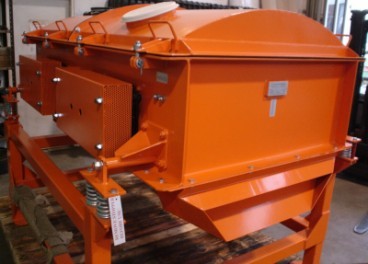
The Ultimate Screener™ (ULS™) compared to a traditional vibrating screen. All traditional vibrating screens are non-resonant, single-frequency linear oscillatory systems. This is also true for oscillating machines. Oscillating screens (TSM – reversible screens and ROTEX-type screens) are also single-frequency, non-resonant linear machines from this perspective. This fundamental characteristic for such screens is no different from that of conventional vibrating machines. Only the Ultimate Screener™ is a resonant, multi-frequency, highly nonlinear vibratory system. It is on this physical basis that claims are made that the specific productivity of the Ultimate Screener™ is always higher than that of a traditional machine, not by a few percent, but by several times and even tens of times (the range is very wide, from 2 to 100 times). It is the fundamentally different vibration pattern that enables significantly greater efficiency than traditional screens and ensures continuous and complete self-cleaning of the screen, i.e., preventing clogging in any process and with any materials. A traditional vibrating screen cannot remain in the resonance region and operates beyond the resonant peak. This is why such a screen is a post-resonant vibration system. In practice, this means that when the external excitation force vector (motor action) is directed upward, the vibration system (mechanism) itself is directed downward, and vice versa: when the external force is directed downward, the machine is in the upward phase. This is why the efficiency of any traditional vibrating screen is less than 1%. Over 99% of the energy consumed by the motor is wasted, primarily on heating the bearings, and only less than 1% is converted into useful work. The Ultimate Screener™ operates constantly in the resonance region, i.e. In the area where the vectors of the external disturbance force and the vibration system itself coincide. The efficiency of the Ultimate Screener™ is approximately 25%. Another striking indicator of this difference is the comparative behavior of a traditional screen and the Ultimate Screener™ after the system has stopped. If a traditional screen is overloaded and stops, the unit does not restart automatically after unloading; it requires an external push. The Ultimate Screener™ does not break resonance under any load. As long as the motor is connected to the power supply and operating, the system remains in resonance and requires no external intervention. Even if the Ultimate Screener™ is overloaded so much that it stops when part of the load is removed, as soon as the external force (the mass of the load) enters the resonant tuning of the system (the Ultimate Screener™), the screen will resume operation automatically without any additional external influences. Every seller of a traditional vibrating screen advertises their machine as the best, superior to others produced by competitors. However, no one can clearly explain how exactly these traditional screens are superior to each other. Why should one traditional screen perform significantly better than another if the principles underlying its operation and reflected in its design are no different from those used by its competitor? Some minor differences can be achieved through better build quality, a more efficient design, more durable materials, etc. Such differences may result in a few percent increase in, say, productivity compared to a similar but lower-quality screen, but will not have a fundamental impact on performance. If a conventional screen, say, from SWECO, can’t separate limestone with a moisture content of 4% on a mesh with a mesh size of less than 8 mm, then it’s safe to say that no other conventional machine can do the job either, be it from DERRICK, TELSMITH, a Russian screen manufacturer, or anyone else. Emphasizing the differences between different brands of conventional screens is nothing more than a marketing ploy, since there is no fundamental physical difference between them, and, accordingly, there is no real justification for the superiority of one brand of conventional screens over others. On the contrary, the Ultimate Screener™ provides: Increased productivity not in percentage terms, but by several and tens of times in cases where comparison with conventional screens is possible; The ability to work with “problematic” materials; The ability to separate into finer fractions inaccessible to conventional screens with certain materials; Separation quality that is fundamentally unattainable when using conventional screens; Complete absence of screen clogging in all cases, including the heaviest ones and those impossible for traditional screens; Ability to handle materials previously considered “unscreenable”; Ability to switch from wet to dry processes where desired; Ability to effectively replace not only traditional screens, but also, in many cases, non-vibrating equipment such as centrifuges, cyclones, etc. The Ultimate Screener™ far outperforms all traditional screens in every aspect, regardless of the application, process (dry, wet or wet), conditions, material being separated, manufacturer and design of the conventional screen offered for comparison. Moreover, the Ultimate Screener™ is always able to process material and/or to such a fine fraction that is absolutely impossible for a traditional screen. A. Performance When a layer of particles is on the surface of the screen of a conventional vibrating screen, all these particles are under the influence of a single external exciting frequency – the frequency (speed) of the screen motor. Every object in the universe, including particles of material on a screen, has its own resonant frequency. However, since all particles—and there are many of them—are affected by the same frequency, a traditional screen doesn’t actually sift them, but simply distributes them across the screen surface until each particle passes through one of the screen openings under the force of gravity. When similar particles are placed on the screen surface of the Ultimate Screener™ multi-frequency screen, each particle immediately “finds” its own resonant frequency, as the screen simultaneously displays a wide range of frequencies, and the distribution of these frequencies across the screen surface changes dozens of times per second. In this case, the effect of the screen motor’s fundamental frequency is completely unnoticeable, since the vibrational energy imparted to the screen and the material on it by the Kroosher® system is hundreds of times greater than that imparted directly by the motor. This results in high productivity, since each particle strives to pass through the mesh opening, as it is influenced by an external force acting on that particle at a frequency that matches the natural resonant frequency of that particle of material. The effect of multi-frequency vibration becomes even more obvious when it comes to screening industrial volumes rather than laboratory tests, where it is important to consider the fact that the layer of material on the mesh surface has a certain thickness. When such a layer lies on the mesh surface of a traditional vibrating screen, the mass of material is exposed only to the fundamental frequency of the motor—and nothing else. The motor speed is low (760–1800 rpm, very rarely 3000 rpm), so the wavelength of the vibration wave created by the motor is quite long (since the wavelength is inversely proportional to its frequency). Calculations indicate that the wavelength is approximately 1 m, but… no one ever loads a 1-meter-thick layer of material onto a screen. This means that a traditional vibrating screen effectively processes a layer of material located 1 meter above the screen surface—a layer that simply cannot exist. With the Ultimate Screener™, the picture is completely different. All particles are exposed to frequencies that match their own resonant frequencies. Because a huge number of frequencies are simultaneously present, a corresponding number of waves of varying lengths are generated within the material layer. These waves can be, for example, 1 mm, 2 mm, 3 mm, and so on. In other words, the entire volume of material is “scanned” and distributed among the corresponding resonant frequencies. Strong pulses “shoot” the material through the entire depth of the layer, ensuring its constant mixing and effective processing across the entire layer thickness. The material “boils” on the screen surface. This creates a vibrating fluidized bed effect, which allows for the effective processing of a thick layer of material, which, in particular, leads to a clear increase in productivity. At exhibitions, we sometimes use a simple but quite effective demonstration. Two identical round screens are used: one with large motors and without the Kroosher® system, and the other with small motors but equipped with the Kroosher® system. The screen equipped with the Kroosher® system is covered with a tall, transparent plastic hood. The hood is approximately 800 mm high. Several dozen multi-colored cotton balls (approximately 10 mm in diameter) are poured onto the screen of each screen. When the screen without the Kroosher® system is turned on, the balls move along the surface of the screen in a normal, familiar manner, without bouncing even 5 mm above the screen surface. This is exactly what happens in industry when sifting a wide variety of materials. Everything happens exactly the same if these balls are placed on any of the dozens of screens presented at the exhibition. The size of the motor plays no role. When touching the screen, a normal, weak vibration is felt. Then, a similar screen is turned on, this time with small, weak motors, but equipped with the Kroosher® system. The balls bounce chaotically and vigorously a full 800 mm and hit the ceiling of the transparent hood. A practical example: screening metal powders, specifically tungsten carbide—a highly abrasive material. With a traditional screen, the throughput was 30 kg/h per m². After replacing this screen with the Ultimate Screener™, throughput increased to 3,000 kg/h per m², a 100-fold increase. Furthermore, the frequency of screen replacements decreased from once every 5-6 days to once every 5-6 weeks. B. Efficiency. In a traditional vibrating screen, fine particles (undersize material) from the lower layers of material adjacent to the screen surface pass through it (provided the material doesn’t stick), while coarse particles (oversize material) remain on the screen surface. This would be fine, were it not for the need to screen industrial volumes rather than laboratory experiments. In industry, the material flows onto and over the screen in a layer of a certain thickness. The higher (or higher) the material layer, the less likely fine particles are to reach the screen and pass through it. They begin to move along with the mass of material and leave the screen through the oversize material outlet before they have a chance to reach the mesh and pass through it. This results in low efficiency (the presence of too many small particles in the oversize material mass that could theoretically pass through the screen). With the Ultimate Screener™, which constantly mixes the material layer, the situation is completely different. Each particle moves along its own trajectory, since it is influenced by its own resonant frequency. This causes voids to appear between the particles. As a result, virtually all small particles capable of passing through the screen are not blocked by large ones, but freely reach the surface of the screen and pass through it, even if they were initially located in the upper layers of the material. This results in very high efficiency. Self-cleaning of the screen, of course, greatly contributes to increased efficiency, since all the mesh cells remain open at all times. Practical example: Screening of coal suspension on a 45 µ (0.045 mm) mesh. A traditional screen is completely incapable of separating coal slurry on a screen with openings smaller than 800 µ (0.8 mm) due to immediate, complete clogging. The Ultimate Screener™, however, delivers separation efficiency on a 45 µ screen of 70 to 94%, which is an order of magnitude higher than the efficiency of conventional screens with 800 µ screens, and also an order of magnitude higher than that of hydrocyclones. B. No Screen Clogging: Screen clogging accounts for 75-90% of all screening problems. Despite the fact that screening is the most efficient and cost-effective method of size separation (and the cheapest separation method overall), its use has always been limited to areas where screen clogging does not occur due to large mesh sizes or favorable characteristics of the material being separated. A significant number of separation processes are carried out wet, as dry screening is impossible precisely because of screen clogging, which causes enormous additional technological difficulties and costs for organizing the wet process and subsequent drying. Moreover, there are a huge number of processes where vibrating screens could theoretically be used, but they were rejected solely because of the problem of screen clogging. The more complex the material and/or the smaller the fraction, the less likely a traditional screen is to cope with this work. Therefore, in many cases, alternative, often inconvenient and expensive devices and methods are used, such as hydrocyclones, air classifiers, centrifuges, etc. The accelerations imparted to the Ultimate Screener™ screen range from 500 g to 1000 g and even more (where g is the acceleration of gravity, equal to 9.8 m/s), compared to traditional screens, which create accelerations of no more than 4-5 g (rarely 10-12 g). With such a high g-force, combined with the powerful pulses delivered by the Kroosher® system from beneath the screen, particles have no chance of becoming lodged in the screen mesh, preventing clogging. There are three main causes of screen clogging: particles of irregular shape and/or similar size to the mesh itself becoming lodged in the mesh; sticky and/or wet material; and agglomeration. Let’s take a closer look: A. Particles of irregular shape and/or similar in size to the mesh itself. On the Ultimate Screener™, an irregularly shaped particle cannot penetrate deeply into the opening and become lodged between the wires of the mesh, because the powerful pulses from under the mesh prevent such a particle from penetrating deep into the opening, “gaining a foothold,” and becoming lodged there. When a particle strikes a wire, it is immediately rejected, and only those particles whose motion vector is directed strictly downward or with a slight deviation from the vertical axis pass through the opening. Obviously, if a particle has an irregular shape and does not fit the opening in any of its dimensions, it strikes the wire and is rejected. A similar particle on a conventional screen is not subjected to any powerful pulses. There is nothing under the mesh of a conventional screen. The mesh is excited only by a rigid attachment to the screen body and high tension. The screen vibration is weak, and irregularly shaped particles easily fall through the holes and become trapped, blocking them, reducing the open area, and eventually clogging the entire screen, making screening impossible. A practical example: screening quartz sand, a material known for its difficult-to-screen nature due to the irregularly shaped particles it contains. The Ultimate Screener™ screens to 100 µ (0.1 mm), 150 µ (0.15 mm), and 200 µ (0.2 mm) sizes—fractions inaccessible to conventional screens. The throughput is 7-8 t/h/m2, i.e., the same as that achieved by conventional screens with screens measured in millimeters rather than microns. B. Sticky Material. The same applies to sticky material, since the energy applied to the screen surface far exceeds the force with which the material adheres to the surface. Pulses with acceleration of hundreds of g’s combined with high amplitude (10 mm versus 2-3 mm on a conventional screen) effectively prevent clogging (sticking) of the screen by the screened material. A practical example: screening wet limestone (3% moisture content). For a conventional screen, this task is impossible when using screens smaller than 8 mm. The throughput of a conventional screen is 4-5 tons/hour per m². The Ultimate Screener™ separates on a 2 mm screen, i.e., 16 times finer, with the same throughput, and separates down to 1 and 0.5 mm with a throughput of 2-3 tons/hour per m². B. Agglomeration. Agglomeration is the bonding of individual particles of material, forming a ball that behaves as a single object. On a traditional screen, with single-frequency vibration, all particles that make up the agglomerate are exposed to the same frequency. Therefore, the agglomerate moves along the screen surface as a single object and is eventually discharged through the over-sieve material outlet, although in reality it is a product that could be separated. The global industry suffers enormous production losses from this effect. Furthermore, agglomerates clog and block the screen openings because they are quite heavy, and weak, single-frequency vibration is not always sufficient to remove them. The Ultimate Screener™ employs pulses with very high energy levels, and it is extremely rare for the energy of mutual attraction between the particles of any given agglomerate to exceed the energy imparted by the Kroosher® system. On the one hand, powerful pulses from beneath the screen break the agglomerate into smaller pieces. On the other hand, each particle within the agglomerate, influenced by its own resonant frequency, moves along its own trajectory, distinct from the trajectories of adjacent particles. As a result, the agglomerate can no longer behave as a single object and disintegrates. A practical example. Feldspar screening. One of KROOSH Technologies’ customers had been screening this material for 20 years and contacted KROOSH Technologies to increase productivity. According to the customer’s PSD (particle size distribution), the feedstock consists of 70% undersize material (product) and 30% oversize material (ballast). After screening with the Ultimate Screener™, it turned out that almost 100% of the material passed through the screen, meaning that everything previously considered ballast was actually agglomerates that could have been broken up and screened with the Ultimate Screener™. This meant the client had been throwing away 30% of the product over the course of 20 years. Some typical examples of the Ultimate Screener™ in action: The material was coffee grounds. Food product. Liquid mass. Fraction separation was 27µ and 15µ. Due to severe clogging, traditional screens with screens finer than 200µ could not handle this material at all. To dewater the material and recycle some of it, the client used a centrifuge. The centrifuge dewatered 50% of the material. The efficiency of material reuse in the production process was 30%. An Ultimate Screener™ with a 27µ sieve was installed next to the centrifuge. The material dewatering rate was 65%. The material recycle efficiency was 90%. After some time, the centrifuge was replaced with an Ultimate Screener™ with a 15µ sieve. The dewatering rate was 70%. The recycle efficiency was 95%. The material was TEBIS (tetrabromobisphenol A). A chemical product, a flame retardant. Dry. The fraction separation was 63µ. A traditional screen could not screen this product even with a 600µ sieve (control screening) due to constant clogging. The Ultimate Screener™ screens the material on a 63µ sieve with a capacity of 1.5 t/hour per m2, separating 15% of the screenings (dust removal) with an efficiency of 97%. The material was dolomite. Wet powder, 4% moisture. Mineral. A traditional screen cannot effectively separate this material into fractions finer than 8 mm due to constant mesh clogging. The Ultimate Screener™ separates on a 2 mm mesh with a capacity of 6 t/hour per m². It can also separate dolomite into 1 mm and 500 µ. Material – Kaolin, a type of clay for the ceramic industry, liquid. Separation by fraction of 150 µ. A traditional screen with a diameter of 1200 mm (area of 1.13 m²) operates with a capacity of 2.7 t/hour per m². The mesh clogs and requires periodic cleaning with pressurized water every 30 minutes. The Ultimate Screener™ operates with a capacity of 10 t/hour per m² without screen clogging.